Event announcement · 3 min read
In Potsdam, OGCR's first annual meeting turns to the EU's future carbon registry
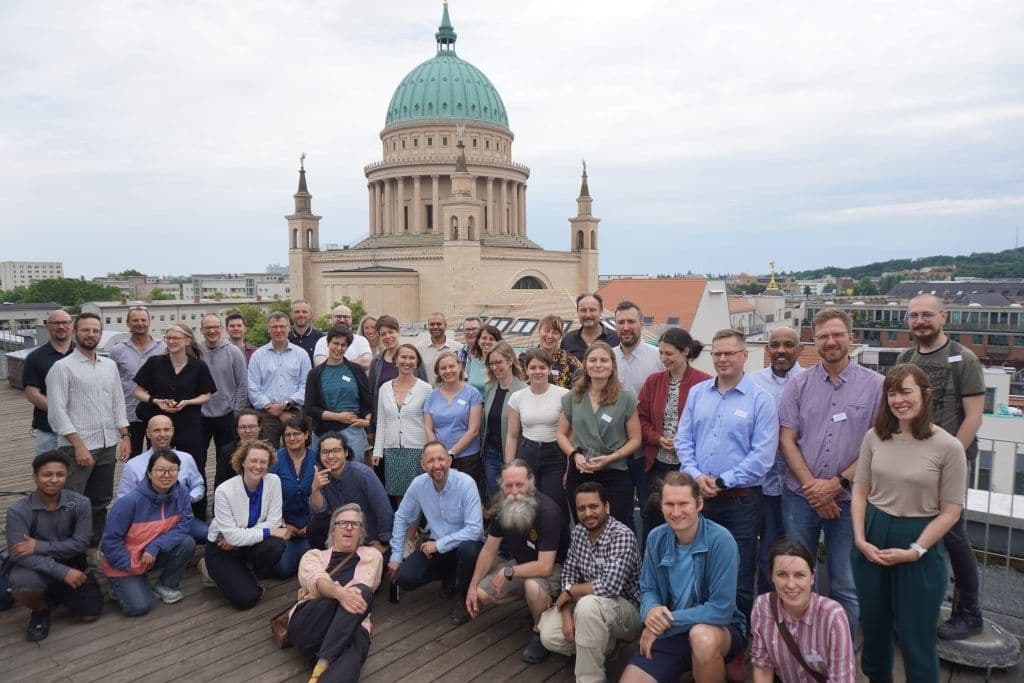
Nearly 50 participants from the OGCR consortium met in Potsdam on 6-8 July 2026 for the project's first annual meeting, hosted by GFZ, with guests from the European Commission's DG CLIMA.
GILAB presented the technical progress of the CRCF Operator Platform and the Parcel Ownership Verification service, tools designed to address the critical lack of reliable soil carbon data currently hindering the European carbon market.
Rules first, data missing
The EU certification framework for carbon removals and carbon farming (CRCF), Regulation (EU) 2024/3012, entered into force on 26 December 2024. It requires every registry entry to record “the geographically explicit location of the activity boundaries, respecting 1:5 000 mapping scale requirements”, and gives the Commission four years to set up an EU-wide Union registry.
The data those rules depend on is incomplete. The Horizon Europe topic that funds OGCR says that “solid and reliable data for establishment of baselines for soil carbon at parcel level across Europe are missing”. OGCR, the Intergenerational Open Geospatial Carbon Registry, is one of two grants under that topic, which drew 11 proposals. Its aims: updateable baseline layers for soil, biomass and peat across the EU, a hybrid modelling framework for management changes under the CAP and the CRCF, and “a globally applicable open geospatial carbon registry”.
Eleven months, from Doorwerth to Potsdam
The consortium first met in Doorwerth, the Netherlands, on 25-27 August 2025. About 60 participants spent three days on CRCF methodologies, open science and cooperation with the sister project CAFAMORE, saw a LiDAR demonstration and mapped the stakeholders the registry will have to serve.
In October 2025 the coordinator presented OGCR in Copenhagen at an EEA/ESA conference on Earth observation for verifying carbon removals. In March 2026, at the European Carbon Farming Summit in Padova, the project held a panel, “Co-Benefits for Whom?”, and a joint workshop with CAFAMORE. April brought its first policy brief, “Unlocking soil carbon: why Europe needs open geospatial registries”; in May, the Natural Resources Institute Finland (Luke) carried out peatland fieldwork in Finsilva forests near Virrat.
Where GILAB fits
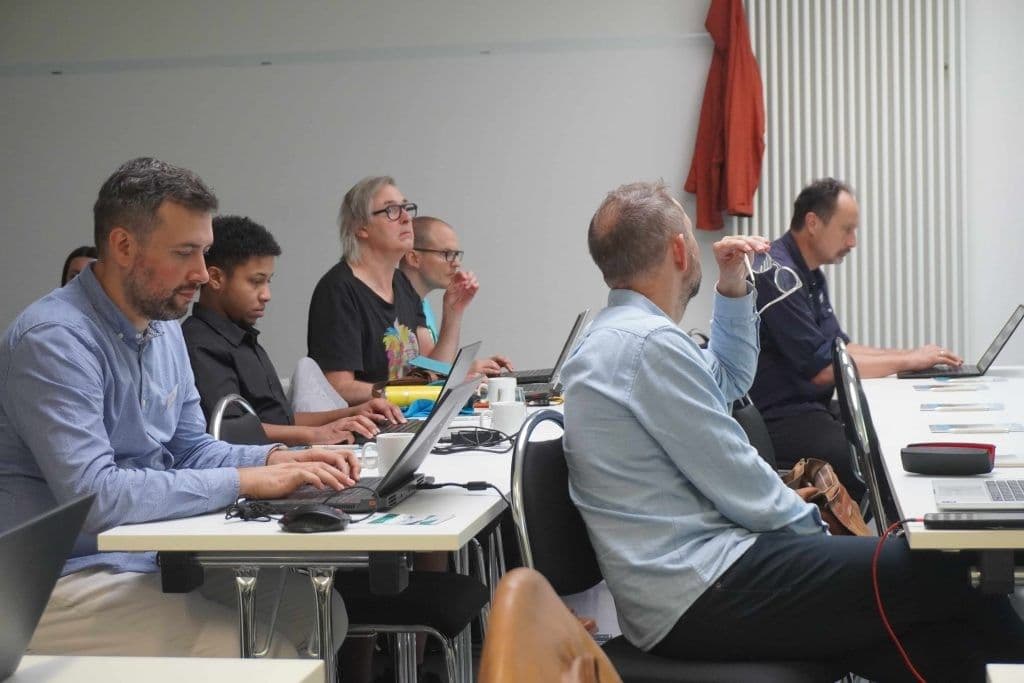
Potsdam meant three days of technical workshops, a joint session with CAFAMORE and DG CLIMA guests covering CRCF implementation and the Union Registry. GILAB, a geospatial company from Belgrade, used it to present the latest progress on the CRCF Operator Platform and the Parcel Ownership Verification service. Both sit where the CRCF meets the map: operators submit an activity plan and a monitoring plan for audit, and the registry must hold the exact boundaries of each activity.
GILAB is one of 18 beneficiaries from 10 countries, and the only one from Serbia.
What is planned next
The next steps are plans, not results. The project's public deliverables table lists first implementations of the registry software components, and milestone M10, “Full system OGCR software V1 published”, for November 2026. A second annual meeting, hosted by Luke in Finland, is planned for 2027; its date has not been announced.
OGCR runs from 1 June 2025 to 31 May 2029 and is coordinated by the OpenGeoHub Foundation based in Doorwerth, the Netherlands. It is funded by the European Union under the Horizon Europe programme, grant agreement 101218854.
More information
Funded by the European Union
OGCR - Horizon Europe, grant agreement No 101218854
Views and opinions expressed are however those of the author(s) only and do not necessarily reflect those of the European Union or the European Research Executive Agency (REA). Neither the European Union nor the granting authority can be held responsible for them.