Project update · 3 min read
Whose carbon is it? Why carbon registries need to know who may use the land
A carbon farming unit is tied to a piece of land. The EU's certification framework defines the operator through its relationship to that land, and the same parcel must never earn units twice.
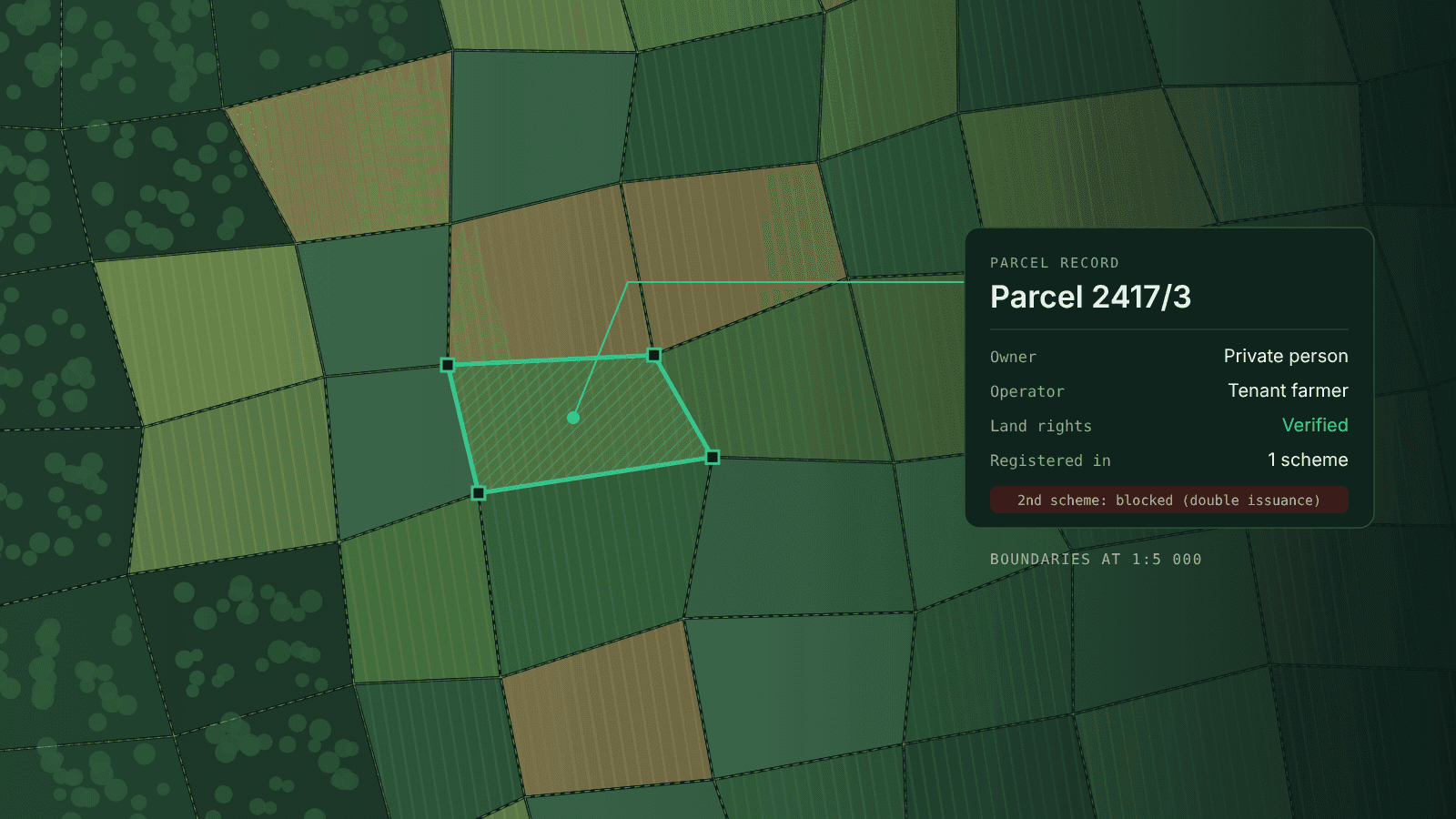
That makes the link between parcel, operator and land rights a precondition for a trustworthy carbon registry.
Who counts as an operator
Regulation (EU) 2024/3012, the CRCF, has been in force since 26 December 2024. For carbon farming it defines the operator as “a farmer..., any other manager of an activity in a terrestrial or coastal environment, a forest owner or manager as defined by national law, or a competent public entity”.
The definition does not stand on its own. Whether a person or company is the manager, owner or tenant of a given parcel is settled by national land law, which differs from one Member State to the next. Who may put a parcel into a certified activity therefore depends on rights to that land.
Changes in ownership of the land and tenure arrangements can also lead to land use change impacting carbon stocks. - European Commission, impact assessment for the CRCF proposal, SWD(2022) 377
Preventing double issuance for the same activity
The Regulation's Annex III requires the registry to record “the geographically explicit location of the activity boundaries, respecting 1:5 000 mapping scale requirements for the Member State”. Until the Commission sets up the Union registry, which Article 12 requires within four years of entry into force, certification schemes run their own registries, and these must be interoperable “in order to avoid double counting”.
A study for the Commission's climate department (Guidehouse and VERTA, February 2025) describes the main risk as “double issuance where the same project activity is registered with more than one certification scheme... and double claiming where the retirement of one certified unit is claimed by more than one end-user”. Exact boundaries show where an activity is; they do not, by themselves, show who has the right to register it.
When land changes hands
The Commission flagged tenure as a carbon issue when it proposed the framework. Its impact assessment notes that “changes in ownership of the land and tenure arrangements can also lead to land use change impacting carbon stocks”, and that activities changing land use “can cause conflict around land tenure and access”.
Carbon farming has to be monitored for at least five years. Over that period the ownership or tenure of a parcel can change, and the registry entry has to reflect it.
What OGCR is looking at
The Horizon Europe call that funds the OGCR project asks for registries that “ensure transparency, full traceability of carbon farming certificates” and “avoid fraud risk and double counting”. The project plans two policy briefs on the subject: one on “how parcel ownership verification complexity varies across Member States” (planned for December 2027), and one on what the CRCF's ownership model means for farmers, service providers and carbon markets (planned for December 2028).
At the project's first annual meeting in Potsdam in July 2026, GILAB presented progress on its Parcel Ownership Verification service. OGCR runs from 1 June 2025 to 31 May 2029 and is funded by the European Union under Horizon Europe, grant agreement 101218854.
More information
Funded by the European Union
OGCR - Horizon Europe, grant agreement No 101218854
Views and opinions expressed are however those of the author(s) only and do not necessarily reflect those of the European Union or the European Research Executive Agency (REA). Neither the European Union nor the granting authority can be held responsible for them.