Project update · 1 min read
Open Soil Spectral Library, for which GILAB developed web tools, gets its PLOS ONE paper
The Soil Spectroscopy for Global Good team published the peer-reviewed paper on the Open Soil Spectral Library (OSSL) in PLOS ONE on 13 January 2025. GILAB is not among the authors; it developed the OSSL Explorer, API and Engine when the library was released in 2021.
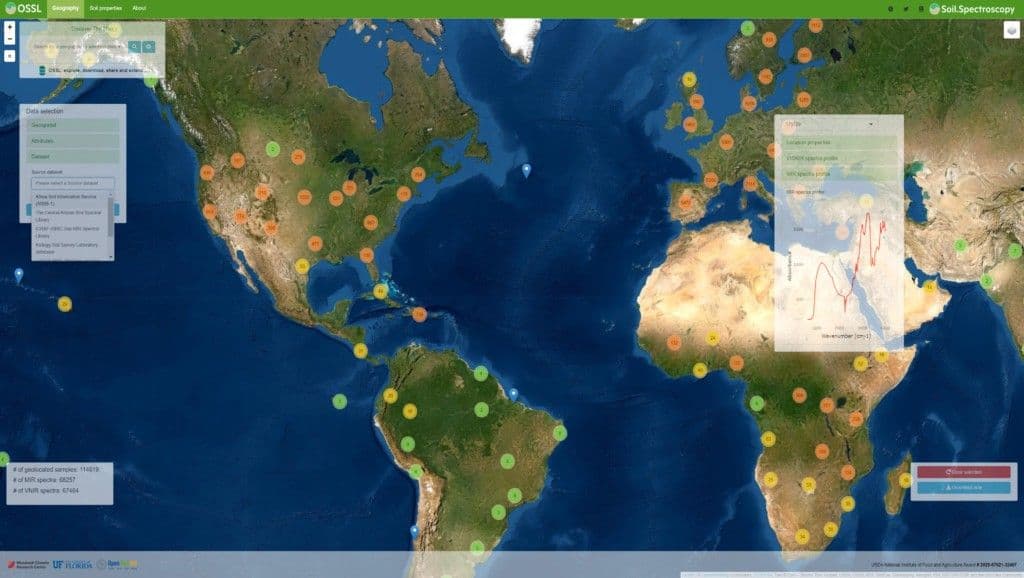
The paper
Safanelli J.L. et al., 'Open Soil Spectral Library (OSSL): Building reproducible soil calibration models through open development and community engagement', appeared in PLOS ONE 20(1): e0296545 (doi 10.1371/journal.pone.0296545); it was received on 14 December 2023 and accepted on 31 October 2024. According to the paper, OSSL v1.2 has more than 135,000 entries and more than 140 calibrated prediction models; the OSSL Explorer shows the 87,707 samples that have spatial coordinates.
OSSL training data and models are available under CC BY 4.0, and the manual and code under the MIT License. Soil Spectroscopy for Global Good (SS4GG), created by Woodwell Climate Research Center, the OpenGeoHub Foundation and the University of Florida, was funded by USDA NIFA award 2020-67021-32467 in 2021-2024.
GILAB's part in 2021
The library was released on World Soils Day, 5 December 2021, and Woodwell Climate announced it the next day. In March 2022 GILAB reported that, in collaboration with Woodwell Climate Research Center, the University of Florida and OpenGeoHub, it had developed and designed the OSSL Explorer, the OSSL API and the OSSL Engine, using R Shiny and R Plumber. The paper itself is the work of the SS4GG partners.