Project update · 1 min read
EcoDataCube.eu described in PeerJ; its back-end and front-end were co-developed with GILAB
A paper published in PeerJ on 6 June 2023 describes EcoDataCube.eu, an analysis-ready, open environmental data cube for Europe. Its authors state that the platform's back-end and front-end were co-developed jointly with GILAB.
What is in the cube
Witjes et al. (PeerJ 11:e15478) describe a European data cube built from Landsat data for 2000-2020 and later years, Sentinel-2 data for 2017-2021 and later years, and a 30 m digital terrain model. Its purpose is to make annual, continent-wide spatiotemporal machine learning accessible to more users by giving them a spatially and temporally consistent set of features.
Reflectance values are aggregated into four quarterly averages that approximate Europe's seasons, plus the 25th and 75th percentiles to keep the variation within each season. Remaining gaps in the Landsat series are filled with a temporal moving window median, which performs relatively better in Southern Europe and worse in mountains such as the Scandinavian Mountains, the Alps and the Pyrenees. In land cover classification experiments, models that used the full feature space - the 30 m terrain model, 30 m Landsat and 30 m and 10 m Sentinel-2 - reached the highest accuracy.
EcoDataCube also hosts open vegetation, soil and land use/land cover maps. All data are released under CC-BY as Cloud-Optimized GeoTIFFs, about 12 TB in total, through a SpatioTemporal Asset Catalog (STAC) and the EcoDataCube data portal.
The back-end and front-end solutions for EcoDataCube.eu were co-developed jointly with GiLAB Ltd, Belgrade, Serbia. - Witjes et al. (2023), PeerJ 11:e15478
From the ODSE viewer to EcoDataCube
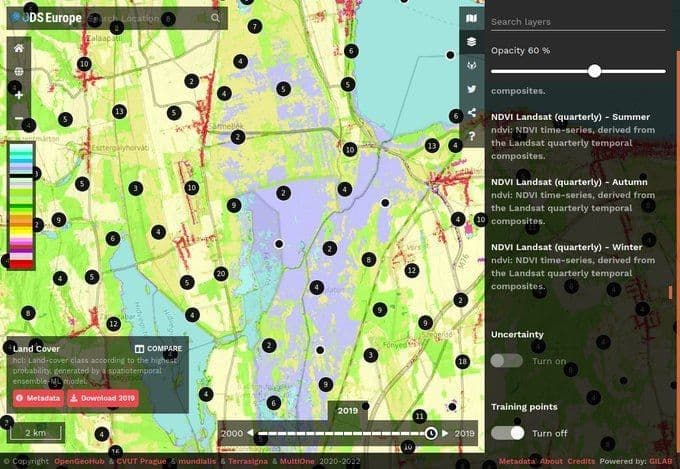
The paper names two sources of funding: the CEF Telecom action 2018-EU-IA-0095 (Geo-harmonizer) and the Horizon Europe project Open-Earth-Monitor (grant 101059548). EcoDataCube's predecessor was the Open Data Science Europe viewer of Geo-harmonizer, whose application GILAB's team developed in cooperation with OpenGeoHub, CVUT Prague, mundialis, Terrasigna and MultiOne; it was released on 1 March 2021. No GILAB staff member is among the paper's authors.